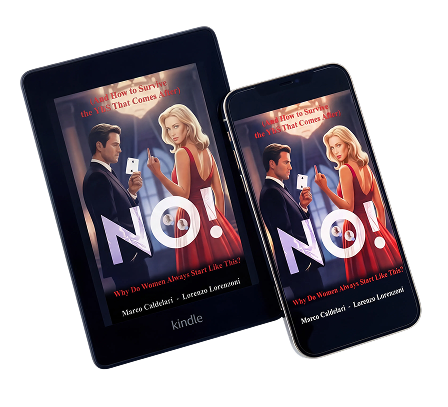
NO!
Why Do Women Always Start Like This
(And How to Survive the YES That Comes After)
A book by men about women’s psychology that women actually want to read.
For centuries, men have been baffled by the female ‘no.’ Instead of dismissing it, two men decided to investigate. Journey with them as they decode the science, history, and humor behind the word that starts countless conversations.

Finally, a Bridge Across the Communication Gap
This isn’t just another relationship guide. It’s a groundbreaking inquiry from an unexpected source. Written by two curious men with the help of a leading female consultant, this book turns confusion into understanding, and frustration into productive conversation.
The Male Perspective: Learn why male authorship makes this investigation uniquely credible and compelling.
Rigor Meets Storytelling: Based on real interviews, scientific research, and historical analysis—not just opinion.
Laugh & Learn: Packed with relatable anecdotes that both men and women will recognize.
Build Better Connections: Get practical insights to improve communication in dating, relationships, and beyond.

What You’ll Discover Inside
1 - NO! The Feminine Art of Starting on the Wrong Foot (But Very Much on Purpose)
Discovering the automatic “no”
The authors explain the “strategic no” — the calm first refusal that often isn’t rejection, but a real-time evaluation tool. In their coffee shop “laboratory,” Sophia reports that about 60% of initial refusals are tactical pauses used to screen for safety, regulate pace, and calibrate genuine interest—revealing more about a man’s emotional maturity than his opener ever will. She then tests the theory herself: she tells Alex “no,” watches him respond with respect and measured humor, and sees how a boundary can surface character rather than end connection.
2 - YES... But Then NO
Strategic Ambivalence
Chapter 2 breaks down “strategic ambivalence”—the yes that buys time, and the no that follows once a woman actually checks in with herself. Through Sophia’s second-date spiral with Alex (a “yes” she regrets, a cancellation, then a recalibrated plan), the authors frame the Yes → No → Yes cycle as refinement, not flakiness: a way to reduce risk, gather information, and align logistics and emotional readiness. The chapter argues that what men often call “overthinking” is layered decision-making, and that the real tell isn’t the change of mind—it’s how both people handle the recalibration.
3 - Men Propose, Women Dispose
The Historical Architecture of Female Veto Power
Chapter 3 explores female veto power—the long, cross-cultural tradition of women shaping outcomes through refusal, delay, and strategic complexity when direct power wasn’t available. With a whip-smart historical sweep (from ancient Egypt to Renaissance courts to 1950s domestic diplomacy and 1964 civil-rights refusal as public leverage), it argues that “mixed signals” are often an evolved governance tool, not a glitch. Back in the present, Sophia and Alex turn dating into a live case study—by their third meeting, they’re analyzing proposals in a gallery of conversation transcripts, where Sophia sees her own veto patterns and Alex learns to treat hesitation as design data, not rejection—bringing the chapter’s opening “70% chance of confusion” forecast into focus as a real, navigable power dynamic.
4 - The Neuroscience of NO
What Happens in Her Brain When She Says No (And He Keeps Trying)
Chapter 4 breaks down the neuroscience behind a woman’s “no,” framing refusal as a neural event rather than a mood. In Dr. Elena Rodriguez’s fMRI/VR studies, women show multi-system activation (threat scanning, conflict detection, intuition, and long-term reasoning), while men tend to process refusal more linearly—and often experience pushback as a status challenge. The chapter explains how pressure can trigger threat-mode in seconds, shutting down clear reasoning, while respectful curiosity shifts the brain into collaboration—making tone and tempo the real deciding factors in whether “no” stays closed or becomes a conversation.
5 - The Philosophy of Rejection: From Socrates to Carrie Bradshaw
The Ancient Art of Saying “No”
Chapter 5 reframes rejection as applied philosophy, tracing women’s “no” from ancient Greece to modern dating culture. The line “Socrates walked so Carrie Bradshaw could say ‘no’ in Manolos” means today’s pop-culture refusals are the stylish descendants of an old intellectual tradition: questioning the premise, slowing the rush to certainty, and protecting self-respect. The chapter links the Socratic method, Kantian ethics, and feminist philosophy to show strategic refusal as moral and psychological calibration—not confusion—then grounds it in Sophia and Alex’s conversations and Amanda’s talk to 200 skeptical academics.
6 - The Psychology of “NO”: When It’s a Test, When It’s a Trauma
Distinguishing Between Strategic and Protective Rejection
Chapter 6 distinguishes strategic refusal (“Is this good for me?”) from trauma-based refusal (“How will this hurt me?”)—two “no’s” that can sound identical but come from very different psychological systems. Through Rachel—who turned down every invitation for three years while her mind ran catastrophes in the first five seconds—the chapter shows how “no” can become a bunker, not a boundary.
7 - Evolution or Revolution?— Stronger Women, More Confused Men
How Power, Autonomy, and Expectation Reshaped Modern Dating
Chapter 7 reframes modern dating as a cultural reset: women are choosing from autonomy (not necessity), so “old scripts” like persistence-as-romance and effort-as-entitlement now read as pressure. The chapter explains the resulting adaptation gap—men using outdated rules, women extending evaluation windows, and both misreading each other—then argues the new baseline is collaboration, emotional literacy, and respecting pacing as part of compatibility.
8 - What If We Said YES?
A Social Experiment (With Unexpected Results)
Chapter 8 flips the premise: it asks women to try a controlled “yes” (public dates, exit plans, real-time check-ins) and studies what happens when strategic refusal is temporarily set aside. The big reveal is that “yes” isn’t naïveté—it’s a diagnostic tool: it surfaces clarity faster (about compatibility, bias, and fear), but it can also expose danger sooner.
9 - The Algorithm of Ambiguity
AI Exposes the Truth About Human Hesitation
Chapter 9 shows how an AI dating model accidentally validates what women have been doing all along: when the cost of being wrong is high, smart systems slow down. Trained on huge volumes of dating-app conversations to optimize long-term stability, the AI “reinvents” strategic hesitation—clarifying questions, delayed commitments, and structured ambiguity—then exposes the real problem humans keep calling “mixed signals”: ambiguity isn’t the enemy, silence is. The chapter lands on a blunt takeaway for modern dating (and for Sophia and Alex): the pause only works when it’s filled with honest conversation and a clear endpoint—otherwise it’s just fear wearing a lab coat.
10 - The New Negotiation
Beyond Yes and No
Chapter 10 moves past “yes vs. no” and argues that most relationship breakdowns are translation failures: people live in unnamed in-between states and then misread each other. After Sophia is cleared to continue her research, she builds a Spectrum of Provisional Commitment (from hard no to strategic maybe to conditional yes to provisional commitment to full commitment) and shows how clarity about your actual state reduces confusion, limbo, and resentment. The chapter lands with Sophia finally using the framework on herself—admitting she’d already chosen Alex in practice—and making the choice explicit.
11 - Exclusive Bonus Chapter
Why Relationships Feel Harder Today (And Why They Aren’t)
Sophia’s five-year research culminates in a paradigm-shifting conclusion: modern dating isn’t chaotic, it’s unscripted. The chapter dismantles the “disaster” narrative, revealing how vanished social structures and an “evolutionary mismatch” create pervasive anxiety. It analyzes the Gendered Risk Gap and the Ambiguity Loop as core dysfunctions, but ultimately uncovers an emerging “Conscious Choice Model”—where people are building more intentional, psychologically literate connections. The final, powerful insight: the perceived chaos is not an ending, but the difficult birth of a new, more authentic form of love based on skill rather than obligation.
The Men Who Dared to Ask "Why?"
Marco Caldelari


Lorenzo Lorenzoni
Lorenzo is the analyst. With a background steeped in research and a natural inclination for deep-dive analysis, he didn’t just experience the puzzle of the female “no”—he felt compelled to solve it. While Marco collected the stories, Lorenzo sought the patterns. He immersed himself in the science, from the neuroscience of decision-making to the psychological principles of communication. He is the architect who structured this journey of discovery, translating personal anecdotes and shared frustrations into a coherent exploration of history, biology, and psychology. His contribution ensures that the book’s insights are not just relatable, but rooted in a credible and fascinating intellectual framework.
We Want to Hear Your Story!
Have you experienced a memorable ‘NO’? Do you disagree with a theory? Share your thoughts directly with us.
or connect with us on social media daily insights and discussions
Ready to Decode the Mystery?
Stop guessing and start understanding. Whether you’re a man seeking clarity or a woman feeling truly seen, this book will change how you think about that two-letter word forever.
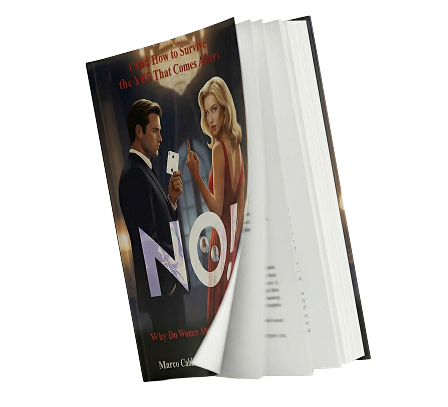
Paperback
A book to underline, revisit and leave on your nightstand
$ 24.90
$ 19.90
How to Read This Book
The Analytical Opening
Each chapter begins with research—psychology, sociology, neuroscience, or cultural history—describing the behavior we’re exploring.
This section grounds the topic in credible evidence before we move into real life.
Credible References & Expert Insight
You’ll see named researchers, real studies, interviews, and occasionally Sophia’s expert commentary.
This keeps the conversation rigorous rather than speculative.
A Narrative Scene Between Sophia and Alex
This is your chance to see the chapter’s idea in motion.
Sophia and Alex are two people getting to know each other as they discuss each theme. These scenes show how the theory plays out in real conversation—not to build a romance plot, but to make the psychological dynamics visible and relatable.
Final Practical Suggestions
Each chapter ends with clear, actionable reflections.
Think of these as field notes—simple tools you can apply to your own interactions.
Questions to the Reader
At the end of every chapter, we pose two questions—one for women, one for men. These aren’t traps; they’re flashlights. Small beams aimed at the part of the story you might be unconsciously reenacting. If you answer them honestly, you may discover more about yourself than you did from the chapter itself.